Ancestry
High Elf
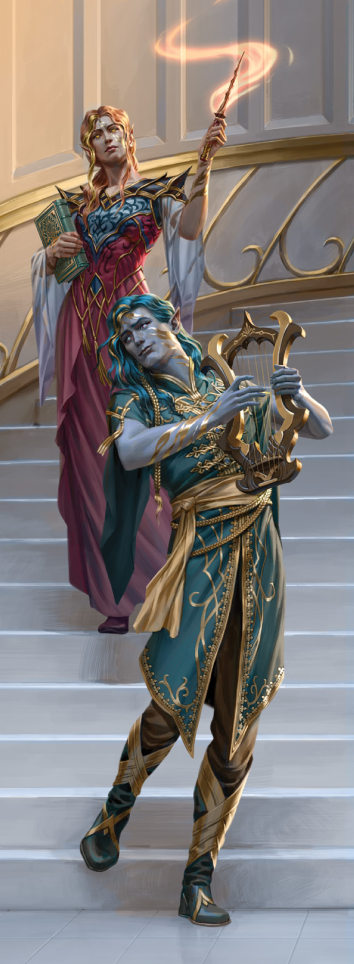
High elves are tall, fine-featured, and long-lived. Age shows in them as composure rather than decay: the oldest are strikingly still, precise in word and gesture, and slow to hurry for anything. Other peoples find this either calming or unnerving, depending on the elf and the day.
High elf infants sing before they can speak — wordless melodies that nobody teaches them. As a child learns words the songs fade, and no adult high elf can recall a note of their own. High elves treat the fading as the true end of childhood, and they do not speak of it lightly.
They believe the Aetherim made them in the earliest ages to be keepers — of knowledge, of craft, and of good order — while the world was still being finished. Nobody can verify this. The belief persists because it matches how they live.
Their culture is anchored to the Age of Song. High elf craft deliberately repeats old forms rather than inventing new ones: a mason working from a model older than living memory considers the faithful copy an achievement, not a limitation. A high elf artisan sees her work as an act of remembering.
They have no homeland, and most live scattered through the mixed towns and cities of the Vale, one or a few to a settlement. Where they do gather, it is around what survives of the Age of Song. Many are found in Crownhold's old centre, living and working among the halls of the first age; and Valmir, the second city of the Vale, is the nearest thing they have to a place of their own — majority high elven, though mixed as everywhere in the Vale is mixed. Some of Valmir is true Age of Song work. The rest was built to look as though it were.
In a mixed community, a high elf usually holds the work of memory: the archive, the schoolroom, the restoration of old buildings and records. It is the counterpart of the dwarven role in shared infrastructure — the dwarf maintains what a town stands on, the high elf maintains what it knows.
They are patient because their frame of reference is long; ordinary setbacks do not frighten them. What they genuinely fear is forgetting. The copying, the teaching, the preserving — all of it is a defence against loss, kept up in the belief that if enough is carried forward, the world stays whole. Which suggests they think it once was not.
Last updated: 25 August 2026