Inhabitants Of Chane
The Vale holds more peoples than anyone has counted. Thirteen of them are numerous enough to be met in an ordinary town, and this is the record of those thirteen. The rest are rare, a family here and there, or keep to hidden places and are known mostly by rumour. It is not a record of nations. No people here has a country of its own; the nearest things to one are Valmir, which is mostly high elven, and the deep wodes of Eastryn, which belong to the wode elves and nobody else, and both are exceptions the Vale remarks on. Everywhere else the peoples are mixed to the household, and have been for so long that nobody thinks it unusual. A child of the Vale grows up knowing that the mason is a dwarf and the innkeeper a polder the way it knows which way the river runs.
Each people keeps an account of where it came from, and no two accounts agree. The high elves say they were made to keep things; the goblins say they were made last, from what was left over; the polders say they were always here. None of this can be checked, and the Vale has never tried to. What a people believes about its making is treated as part of what it is, like its height or its trades, and left alone.
What the Vale does notice is the particular. It knows what each people does, where it tends to settle, what it is good at and what it is accused of, and which of its members deserve a second look when they turn up somewhere unexpected: a hakaan on the road, a revenant at the door, a wode elf inside the walls. The pages that follow are written from that side. They say what each people is like to live beside, what its neighbours have learned to expect of it, and where the neighbours are wrong.
Any of them may be a hero.
Devil — Hell's blood in mortal shape, marked by horn, hoof or tail. Descended from summonings that went wrong, most are simply people of the Vale now; the houses of Hell that made them still trade in souls.
Dragonkin — rare and dragon-like, raised to a duty whose origin is long forgotten; steadfast, fierce, and true.
Dwarf — compact and powerfully built, dense enough to turn a blow, with a mineral grain that rises through hair and beard in age. Builders and delvers whose work is meant to outlast them; disputes are settled in the hall, aloud and witnessed.
High Elf — tall, fine-featured, and long-lived, with age showing as composure rather than decay. Keepers of what survives from the Age of Song; they sing before they can speak, and fear forgetting more than anything.
Wode Elf — slight and quiet-moving, with long pointed ears and large dark eyes that are the one thing people remember about them. Their glamor makes what people see uncertain. Guides and misleaders both; the deep wodes of Eastryn are theirs.
Goblin — the smallest people: wiry, green-skinned, ears swept back, a wide mouth full of pointed teeth, and hands that are never still. Anything unfamiliar gets taken apart and put back improved.
Hakaan — nine-foot giants of living stone, friendly and open. Some see their own death coming, and custom says they must go to meet it.
Human — the most numerous, with no common look and no shared origin. They sense the supernatural before they see it, and answer an unpredictable world by building towns and bonds.
Memonek — porcelain-skinned and precise, lighter than they look, made for a purpose nobody remembers. They fill the gap with order, and with a loyalty to whatever they have chosen to serve that makes them the most dependable people in the Vale.
Orc — big, broad and heavily muscled, green-skinned and tusked, the strongest of the Vale's peoples and the slowest to show it. A fire in the blood lights when they are hurt; restraint is their whole culture.
Polder — three and a half feet tall and completely self-possessed. They melt into shadow, and they are the hardest people in the Vale to frighten.
Revenant — the dead who came back because something was left unfinished. Any of the peoples may return this way, in the body they died in, wearing the marks of their death.
Riftborn — four-armed, with faceted crystal eyes, marked by an ancient rupture so that time runs slightly wrong around them. Careful, watchful, and steadier than they look.
Devil
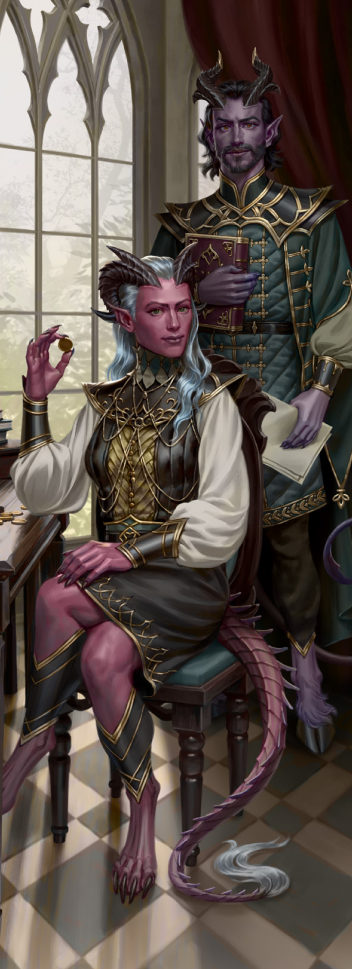
Devils — or demons; in the Vale the words mean the same thing — are the blood of the underworld walking in mortal shape. Most stand human enough in outline, but none pass unmarked: skin in some shade of red or blue, dull crimson to deep violet, and always at least one hellmark to give them away — a crown of horns, a barbed tail, cloven hooves, a forked tongue, teeth made for tearing, a pair of wings too withered to lift them. The marks keep no rank. A prince of the underworld and the lowest of his servants may bear the very same horns.
They name their homeland the Seven Cities of Hell, though “cities” flatters it. They are seven houses — rival dynasties of the damned, each ruled by a prince who claims the others’ seats and holds none but his own. Their courts turn on old and cruel pleasures: flattery and torment, beautiful things and broken ones, hungers a mortal would rather not have named. But what every house wants, beneath all the rest, is souls — and the endless quarrel between the houses is, at its heart, a contest over who will gather the most.
A devil reaches the living through the bargain. Where a mortal can be tempted to call one up — for power, for knowledge, for a death turned aside — a house will send a servant to seal the pact and stand surety for it, and the price, always, is the soul, collected at a time of the devil’s choosing. It is patient, hungry work, and the houses have been at it a long while.
Not every summoning ends as the summoner hoped. When the rite breaks before the pact is sealed, the devil it called is left here, cut off from its house and its hell with no way home. Some claw after a way back; many do not. Generations on, their descendants are simply part of the Vale — born here, raised here, carrying the old marks and little of the old purpose, making lives as merchants and soldiers and neighbours among peoples who have mostly chosen to forget what they are. Mostly.
And not all the blood of Hell wears a courtly face. For every devil who keeps a name and a trade, there are things in the deep places that kept only the hunger — feral, half-shaped, going by other names if they are named at all. The Vale calls those demons too, and is not wrong to.
Dragonkin
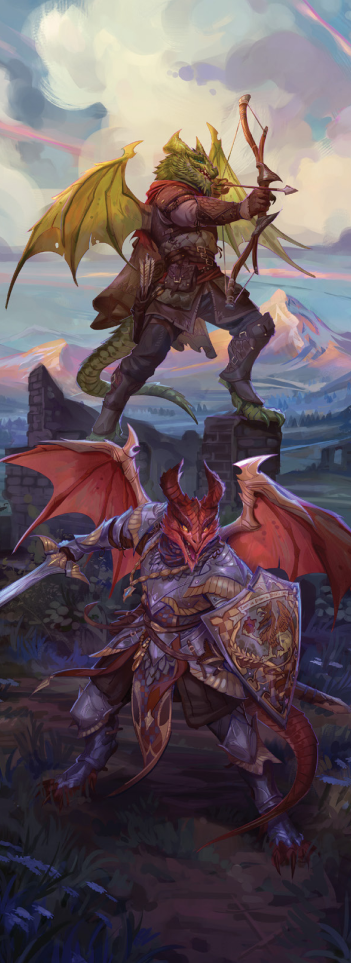
Dragonkin are rare, and live in small enclaves scattered across the Vale. They are scaled, in bronze and coal-black and emerald and a crimson so deep it shows black until the light turns it, and each carries the dragon’s mark somewhere — a crest of horns, a ridge of heavy brow, a line of frilled spine, talons that keep their edge. No two clutches are alike, and even within one the young seldom match.
Their clutches are small, an egg or two and seldom more, and from this two things have always followed: the dragonkin are few, and what new forms appear among them appear slowly, a little changed across many generations. Where the line first came from, none can say for certain. They tell of an ancestry among great beings of fire, present near the making of the world — an old belief, with nothing left to prove or deny it.
What dragonkin hold to is not where they began but what they were once for. Their oldest memory, worn down now to a name and little else, is of the Dragon Phalanx: an order out of the world’s first ages, raised to stand for order and to put itself between the world and the things that would unmake it. What it was, who it answered to, how it came apart — all of that went with the Sundering.
What remains is the impulse. Most dragonkin are raised to a duty no one taught them to want: to use strength with restraint, to answer for what that strength does, and to stand between the strong and the weak when no one else will. Not all of them carry it, and those who do could not always tell you why. The reason is not lost — only the dragonkin have lost it; it is kept elsewhere, by those who do not forget. But it holds often enough that others have come to count on it, and a dragonkin who has forgotten everything else will still try to live as the dragons of old are said to have lived: steadfast, fierce, and true.
Dwarf
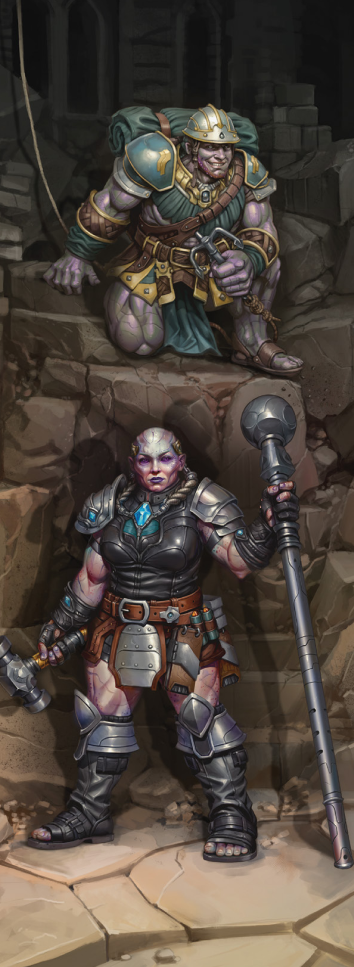
Dwarves are compact and powerfully built, their flesh and bone dense enough to turn a blow that would break another body. They hold this comes of an old kinship with stone and the deep places, and the kinship shows on them: in age, a fine mineral grain rises through the hair and skin, brightest in the beard, which a dwarf keeps oiled, polished, and cut to long custom.
Across the Vale, dwarves are the builders, engineers, and delvers, and their work is made to outlast them. They prize what is solid and proven over what is new: a method is kept because it has held, taught from one mason to the next with little change. They build down to bedrock and into cliff faces, and where they settle among other peoples they tend to take on the shared works no one else will, the walls and drains and foundations a town forgets about until they fail.
Their gatherings carry several purposes at once. One evening in one hall may hold a dispute, a celebration, and a remembrance together, settled through argument, song, and oaths spoken aloud so they are witnessed and cannot later be denied. This is how a scattered people keeps its memory and its obligations, in company rather than in writing.
Most dwarves hold that Ord made the world, and made it deliberately, every part set where it was meant to go. From this comes their watchword, “what will be, will be”: not a shrug at fate, but trust that a world built with such care runs to a purpose, and that work done properly will last because lasting is in the nature of a well-constructed thing. A dwarf rarely signs what they make. The work speaks for itself, sound and in use long after the maker is forgotten.
High Elf
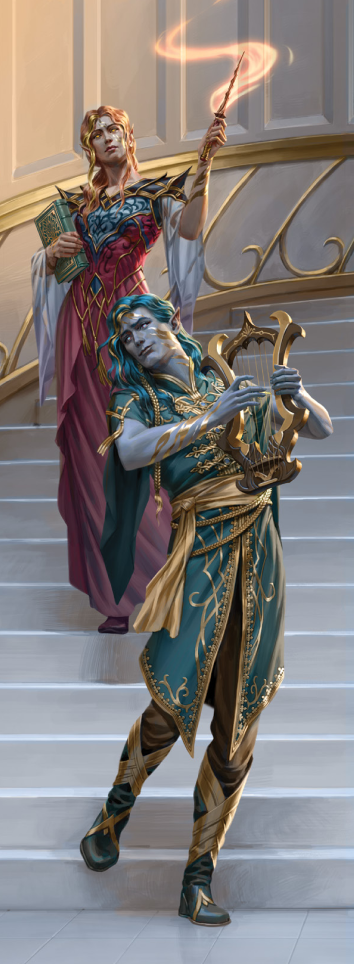
High elves are tall, fine-featured, and long-lived. Age shows in them as composure rather than decay: the oldest are strikingly still, precise in word and gesture, and slow to hurry for anything. Other peoples find this either calming or unnerving, depending on the elf and the day.
High elf infants sing before they can speak — wordless melodies that nobody teaches them. As a child learns words the songs fade, and no adult high elf can recall a note of their own. High elves treat the fading as the true end of childhood, and they do not speak of it lightly.
They believe the Aetherim made them in the earliest ages to be keepers — of knowledge, of craft, and of good order — while the world was still being finished. Nobody can verify this. The belief persists because it matches how they live.
Their culture is anchored to the Age of Song. High elf craft deliberately repeats old forms rather than inventing new ones: a mason working from a model older than living memory considers the faithful copy an achievement, not a limitation. A high elf artisan sees her work as an act of remembering.
They have no homeland, and most live scattered through the mixed towns and cities of the Vale, one or a few to a settlement. Where they do gather, it is around what survives of the Age of Song. Many are found in Crownhold's old centre, living and working among the halls of the first age; and Valmir, the second city of the Vale, is the nearest thing they have to a place of their own — majority high elven, though mixed as everywhere in the Vale is mixed. Some of Valmir is true Age of Song work. The rest was built to look as though it were.
In a mixed community, a high elf usually holds the work of memory: the archive, the schoolroom, the restoration of old buildings and records. It is the counterpart of the dwarven role in shared infrastructure — the dwarf maintains what a town stands on, the high elf maintains what it knows.
They are patient because their frame of reference is long; ordinary setbacks do not frighten them. What they genuinely fear is forgetting. The copying, the teaching, the preserving — all of it is a defence against loss, kept up in the belief that if enough is carried forward, the world stays whole. Which suggests they think it once was not.
Wode Elf
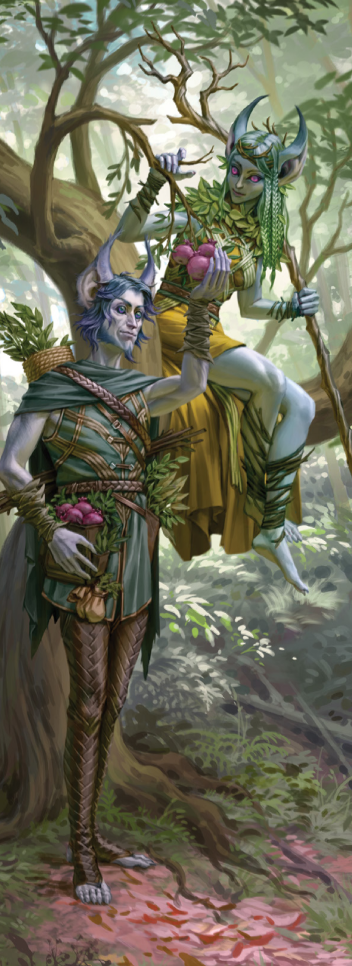
Wode elves are slight and quiet-moving, with long pointed ears and large, dark, reflective eyes. The eyes are the one feature people reliably remember: the rest of a wode elf is oddly hard to hold in memory, and two descriptions of the same elf often disagree.
That is the working of their talent, which is called glamor. Glamor is not invisibility; it makes people pay less attention to a wode elf than they meant to. A wode elf can stand in an open street and go unremarked, because everyone nearby has just found something else to look at. In the forest it has leaf-shadow and birdsong to work with; in a town it makes do with corners, crowds, and doorways nobody uses. It is partly skill and partly instinct: it strengthens and weakens with mood, and most wode elves learn to direct it.
Many wode elves say they descend from the sylvan spirits of the wodes, the deep forests. Not all of them believe it, but nearly all feel the connection: even a town-raised wode elf grows uneasy in places with no green in them. A forest is something they belong to, not somewhere they visit, and they speak of damage to one the way other people speak of injury.
The old blood keeps to the deep wodes of Eastryn, in the Vale's misted east, and most Vale folk will never knowingly meet a deep-wode elf. The rest live scattered through the mingled towns, usually nearer the settlement's edge than its centre.
Among the other peoples of the Vale they are known as misleaders of travellers and quiet tricksters. The stories repeat themselves: guides who arrive unasked, directions that prove accurate only partway, companions who vanish once their usefulness has passed. Wode elves rarely deny the stories, and sometimes quietly confirm them. From their side nothing was abandoned; the interaction ended when interest did.
In a mixed community a wode elf usually takes the work of the edges. The dwarf maintains what a town stands on and the high elf maintains what it knows; the wode elf knows the country around it — what moves past the last fence, which paths are safe, and which have stopped being safe. They work as foresters, guides, and finders of lost things and lost people.
They dislike confrontation, and prefer an encounter to end before it becomes one. In the deep wodes the watching is constant: a careless traveller is turned around without being able to say when it happened. Most of the misleading is not play. A traveller turned aside is usually being turned aside from something. Wode elves guard the deep forest like people keeping something undisturbed, and they do not say whether that is for the traveller's sake, or the forest's.
Goblin
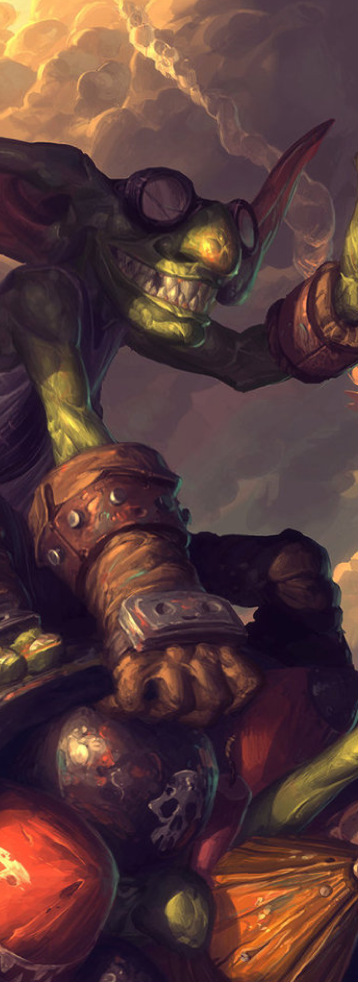
Goblins are the smallest of the Vale's peoples: wiry, green-skinned, with long ears swept back and a wide mouth crowded with pointed teeth. The grin is what people expect; the hands are what matter — quick, precise, and rarely still.
Most goblins cannot hold an unfamiliar object without starting, half-consciously, to take it apart. The hands go looking for seams and fastenings while the goblin talks about something else. What is taken apart is put back together, usually working, and often improved in some small, surprising way.
Goblins say they were made last, out of what was left over when the other peoples were finished. They offer this as the reason nothing in the world quite fits them — tools too heavy, doors too tall, chairs too high — and the reason they have been adjusting the world ever since. Whether a given goblin believes it or not, they all act on it.
There are not many goblins in the Vale, but there are goblins everywhere. No place is unappealing to a goblin provided there is something in it to fiddle with, so they turn up in every quarter of the Vale and settle wherever the work is thickest — workshops, market lanes, tinker yards, docks. Few towns hold more than a handful, and almost no town is without one.
Their reputation runs ahead of them. Some call them problem-solvers who notice what everyone else overlooks; others call them meddlers who explore private spaces, appropriate unattended items, and provoke small disorders out of pure interest. Goblins treat both accounts as familiar and contest neither, because they describe the same habit from its two ends: the goblin who took your gate latch apart uninvited is the reason it never sticks again. They are rarely malicious. The world is a set of practical problems, each open to adjustment, and a small disruption is an acceptable price of finding out.
Goblin society is a dense network of family, associates, and adopted kin, and loyalty inside the circle is worked at, not assumed. Skill and usefulness outrank birth and formal standing, and reputation travels fast and lasts.
If something breaks in a goblin neighbourhood, it is fixed before dawn. If something has gone missing, it is worth waiting until morning before making accusations — things in goblin quarters have a way of coming back improved.
Hakaan
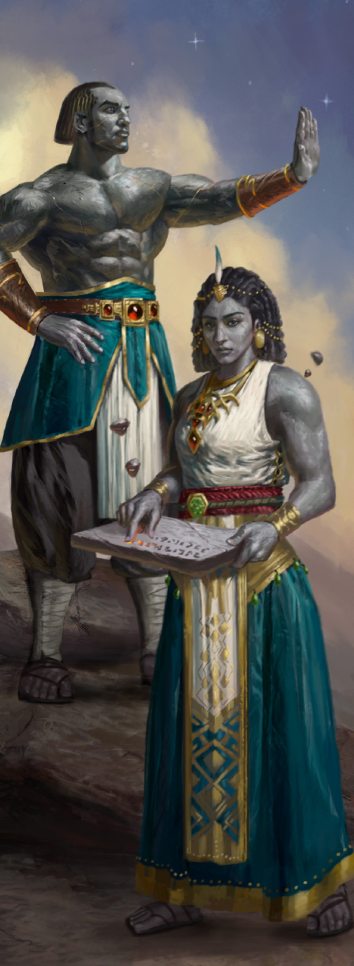
Hakaan are the largest of the Vale's peoples; a grown hakaan stands over nine feet tall, and their bodies are made of living stone, grey and heavy. They are strong in proportion, and most of the Vale meets them in the trades that need that strength: the quarry, the mill, the building yard, the haulage road.
What sets them apart is Doomsight. A hakaan may, at any point in life, see their own death: one clear moment showing how it comes and where. It never shows a quiet death in bed; the death it shows is always caught up in some larger event, a flood, a war, the fall of a house. Not every hakaan receives it, but one who does is expected to go and meet it, and hakaan custom treats refusal as a disgrace that falls on the whole household rather than on the one who turned away.
Hakaan account for Doomsight through their origin. They believe they descend from giants of the first age, stone beings far larger than any hakaan living, and that those giants bargained with Cyrvis for foresight. Cyrvis took their size and strength in payment, and then, as a trickster does, kept to the letter of the bargain and no further: the giants had asked to see the future, and he let them see only one part of it, the part nobody wants to see. Hakaan therefore think of themselves as a diminished people, the remainder of that bargain: cheated, and still keeping their side of it. It has left them with no particular feeling toward Cyrvis; they neither worship him nor blame him, and unlike most of the Vale they will say his name in ordinary conversation.
Because Doomsight is the only reason most hakaan ever have to leave home, hakaan do not travel by choice. Most are born, work, and die in one place, whether a farming village of their own or a hakaan quarter in one of the larger towns, and they take the Saints of that place as their own. Their names record this. At home a hakaan uses a single forename. Away from home they add a marker naming where they belong, 'of Kanzu' or 'Kanzu-kin', and a hakaan who names no home at all is called Outwalking.
This is why a hakaan on the road is treated across the Vale as a bad omen, and the belief is correct. A travelling hakaan is almost always following their Doomsight, and Doomsight comes to far more hakaan in troubled years than in quiet ones, so when several are seen leaving home at once, something large is moving in the world.
None of this makes them grim. Hakaan are friendly, open, and quick to trust, and the likely reason is that a people who might learn the day of their death at any moment see little point in spending the days before it being guarded. The one thing hakaan custom does not forgive is a hakaan who saw their death and did not go to it.
Human
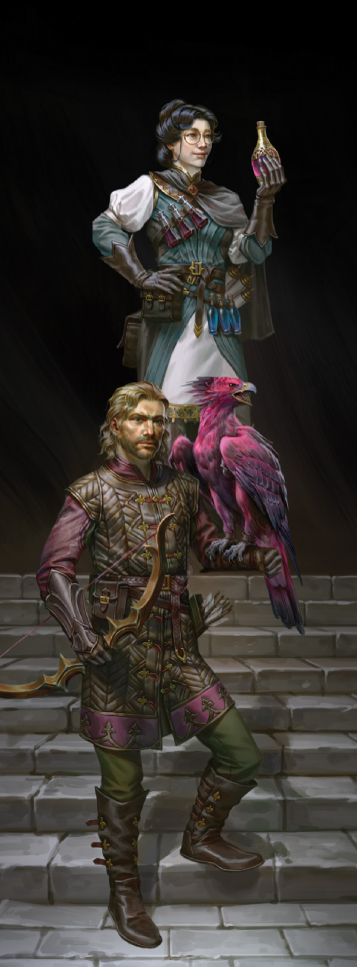
Humans have no common look. They are tall and short, broad and slight, and every shade the Vale holds; nothing about a human's face tells you where their family came from. Among the peoples of the Vale they are the hardest to generalise about, and the most numerous.
What humans share is a sense. They feel the supernatural before they see it — an oily smell in the air, a prickle on the skin, hair rising when the undead are near. Graveyards press on them in a way few of them can explain. Magic's hold on them is light, and whatever drives the undead, something in human nature refuses it.
They have no shared story of where they came from. Every district and family keeps its own account, none of the accounts agree, and few humans think the question important. Ask a human what they are and they will name a town, a trade, or a household before they name a maker.
What they do instead of remembering is build. Villages, guilds, caravans, households, and alliances form quickly wherever humans settle, and the bonds are made from shared labour and lived experience rather than blood. Stability is treated as work — everyone's, all the time. The world feels unpredictable to a people who can smell it coming, and their answer is to bind themselves together.
They are the most numerous people of the Vale, and the majority in most of its settlements. A human town is rarely a human place alone: they build to be joined, and most of the mixed quarters of the Vale began as human streets that other peoples moved into and were welcome.
In any community, humans tend to hold the connective work — the reeve, the clerk, the innkeeper, the caravan master, the neighbour who knows everyone's name. Gathering people into something larger than the sum of its parts is the thing humans are best at.
They meet the unknown with caution first and stubborn bravery after. No one can say why humans sense what the other peoples do not, and humans rarely discuss it. They light their lamps at dusk, wall their towns, bury their dead carefully, and are seldom caught unprepared.
Memonek
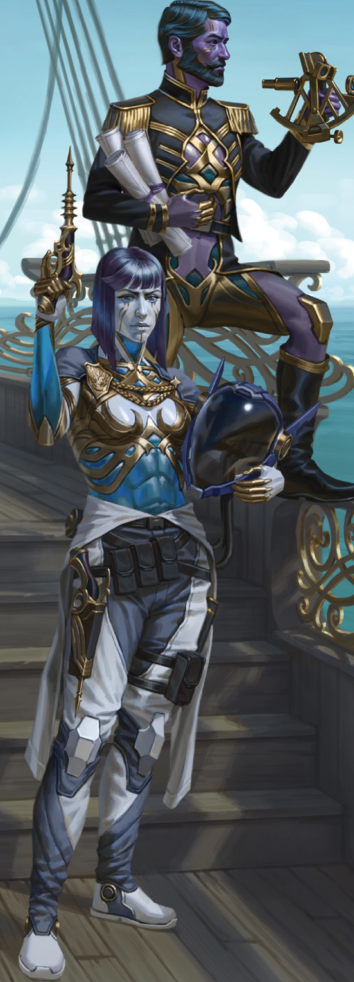
Memonek traditions speak of a purpose long forgotten. Their oldest accounts say they were made, shaped for a single task that has since been lost, and that they did not come into the world by chance or lineage but with intent, toward an end that never arrived. Whether this is history or interpretation nobody can say. What is certain is how memonek live with it: a steady sense that something important was left unfinished, and that it was theirs to finish.
Their bodies look the part. Memonek skin has the smooth, cool finish of porcelain or polished stone, in pale blues and lilacs, with faint metallic patterns showing beneath the surface. Their features are symmetrical and precise, their eyes steady and slow to blink, and they are lighter than they appear; a memonek weighs less than a human of the same height and takes a fall that would hurt one. Every movement carries an impression of control, as if each gesture had been practised beforehand.
Their minds are held to the same standard. Emotion reaches a memonek suddenly and with more force than they know what to do with, and their answer is order: speech is measured, routine is kept, action follows thought and never impulse. None of this is a claim to be better than anyone else. It is a defence, and behind the defence is the unnamed purpose. A people built to serve something, and left with nothing to serve, will fill the gap with discipline, and memonek do, as if enough order might stand in for the thing they were meant to do.
The same need shows in how they live. Memonek attach themselves: to a guild, a household, a crew, an office, sometimes to a single person, and once attached they hold. They are among the most dependable people in the Vale for that reason, and many quietly dream of a realm of perfect order, a place where everything behaves as it should and nothing pulls the heart off balance. Some say such a place once existed. Others think it is only their nature, wishing.
They carry a single formal name and nothing else. There are no family names, because the tradition never formed, and the name is not shortened; a memonek called Selithene is Selithene to friend and stranger alike. Some add a designation of office for civic use, 'Anselm of the Fourth Cohort', which says what they serve and is the nearest thing a memonek has to a surname.
Memonek are few, and found where clarity and precision are valued: the registry, the counting house, the surveyor's chain, and the ships of the Vale's ports, where a steady hand and a settled mind are worth more than strength. They do not want to rule the world. They want to find their place in it, one ordered moment at a time.
Orc
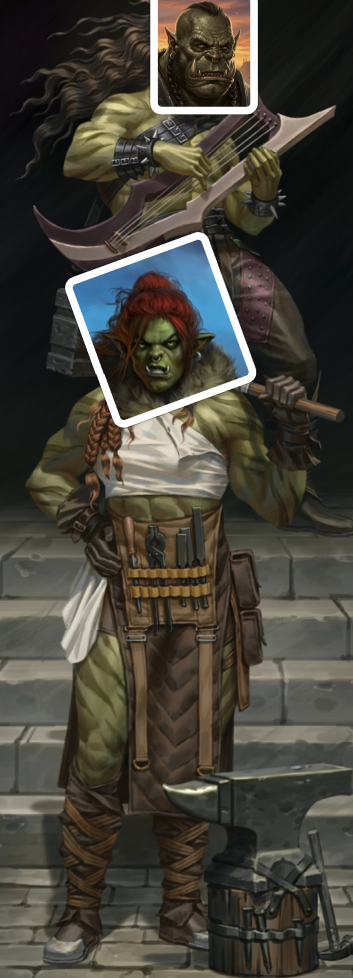
Orcs are broad, heavy-framed, and green-skinned, with prominent lower tusks. Strangers read the build as a soldier's; more often it was earned at a forge, a quarry, or a field. They are the strongest of the Vale's peoples, and the slowest of them to show it.
Every orc carries a fire in the blood. When an orc is hurt, their veins light under the skin with a dull glow, pain stops slowing them, and their body will go on past limits that would stop anyone else. Orcs describe the state as standing at the edge of themselves. It is not madness — focus narrows, and an orc in the fire finishes what they start.
Orcs say they were made early, when the world was still hot, and that the heat never entirely left them. Nobody can verify this, but unlike most origin stories the evidence glows: the fire is there for anyone to see, and orcs point to it and consider the question settled.
Because every orc lives beside their own fire, orc culture is built around restraint. Consent and clear warning are taken seriously; anger is treated as a force to be managed, not indulged; and violence without cause is counted a failure, not a strength. Conflict, when it comes, is meant to end decisively — restoring quiet and leaving no cause for return.
They prefer their own ground. Most orcs keep to farmsteads, smallholdings, and workshops at the quiet end of town, and they avoid the press of the great cities, where small misunderstandings pile up faster than patience can clear them. Those who do settle in cities form compact households and working crews that keep familiar rhythms. It is not fear and it is not hostility; it is the practical management of a nature that runs hot.
The fire has to go somewhere, and mostly it goes into work. Orcs favour trades with heat and repetition in them — the forge, the kiln, the brewhouse, the field — and orc-made goods carry a reputation for being finished properly. Their neighbours know both halves of the arrangement: an orc's patience is long, and it is not endless.
Polder
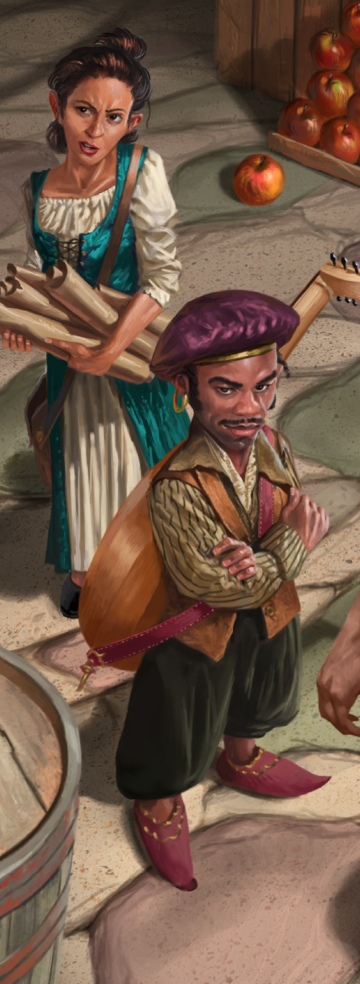
Polders stand about three and a half feet tall, and they are built like the big folk in miniature, not like children. Parts of the Vale say halfling instead; polders answer to both. They dress well when they can, and they carry themselves with complete self-possession: a polder does not consider themselves small so much as they consider most other people unnecessarily large. After humans they are the most numerous people of the Vale.
Their talent is called shadowmelding, and it is stranger than its reputation. A polder against a wall or floor does not hide in the shadow — they become it, flat and silent, until they choose to step out again. Polders themselves insist the talent is overrated. The big folk, they point out, are simply loud: the walk, the sitting down, the standing up, every one of them announced. A polder does quietly what everyone else does noisily, and is called uncanny for it.
Ask where polders come from and the answer is here. They have no migration story, no maker, and no memory of ever having arrived; as far as any polder is concerned, polders have always been wherever people gather. Scholars find this unsatisfying. Polders do not.
They live where others live — most of all where humans live, whose customs, jokes, and rhythms they absorb without effort. There are polders in every town from the Fingers to the sea, and few inns or kitchens anywhere without one somewhere about the place. Their faith follows the local custom, offered to the same Saints as their neighbours — and many towns proudly claim a polder saint of their own.
They are at their best in the trades of welcome — the inn, the kitchen, the market stall — and in any work where knowing everyone is the skill. They take poorly to instruction, and they know it: everybody wants a polder cook, as the saying goes, until they try to tell one what to cook.
The shadow talent has earned them a long reputation as thieves and spies. Polders dispute the charge, pointing at the inns and the kitchens, and for most polders the dispute is fair. But polders who are not upstanding tend to be too good at thieving to be caught. What annoys a polder is not the accusation but the assumption.
One more thing is commonly said of them, and it is true: they are the hardest people in the Vale to frighten. Nobody has explained why courage settled so heavily in the smallest of the peoples. Polders do not explain it either.
Revenant
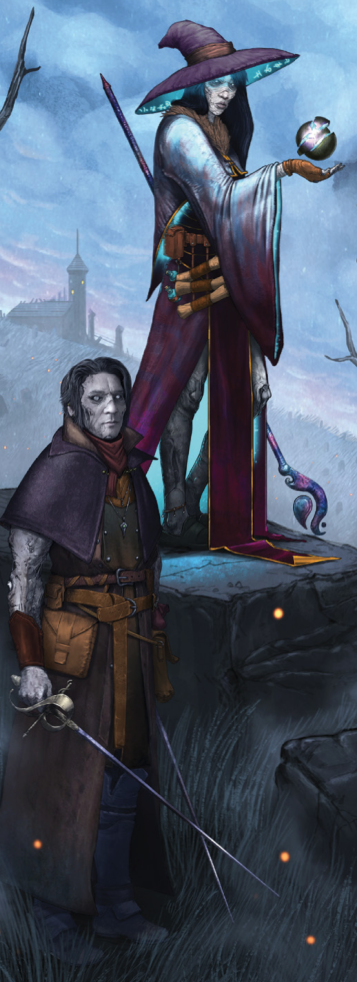
A revenant is someone who died and did not stay dead. They come back in the body they had, of whatever people they were born to, and the body is plainly a corpse: the skin grey and cold, the eyes ringed dark, the wound or sickness that killed them still there to be seen. Whoever they were before, they are that person still, with the same memories and the same name, and the same face wearing the fact of its death.
Every soul goes to the Crucible to be weighed. This is taught across the Vale from childhood, and a revenant is what the teaching does not cover. They did not rise by necromancy; no one called them. They are held to be souls that reached the Crucible with a purpose so unfinished that they turned back at its door, and the Vale has not agreed on what that means. Priests of Cavall hold that judgement was postponed, not escaped, and treat a revenant as a case not yet heard. Cyrvis's hidden worshippers claim the return as his work. A death is the plainest thing fate appoints, and a soul turned back from it is fate defied; to Cyrvis that is reason enough, and his followers say he does it for the pleasure of the interference as much as for any use the returned dead might be to him. They point out that a revenant's purpose is very often revenge, which is his to give. Country folk say prayers against the undead and bar the door. All three are belief. What is known is that revenants are few, and that each one came back for a particular purpose, and a purpose strong enough to turn a soul from the Crucible is seldom a gentle one.
The body they came back in keeps only what it needs. A revenant does not breathe, eat, or drink, and cold and poison pass through them without effect. Fire is the exception, the one thing that ends a revenant, and they know it; every other hurt, however grave, only stills them for a night, and by morning the body has gathered itself and stands again.
What brought them back is the centre of their lives. It may be a debt, a person, a wrong, a thing left half made, and a revenant will name it if asked. A revenant who completes their purpose is not seen again. It is generally held that they go, at last, where they were going.
Revenants are rare, and small places fear them. A village that has never seen one will hurry its children indoors, and a revenant learns to arrive by daylight and to say early what they want. Many keep to the roads for that reason. Others go to Crownhold, where a dozen peoples share every street and one more grey face draws little notice. There are enough of them in the city that a few temples keep a bench for them, near the door.
They have the patience of someone who has already died once. The things that hurry the living, hunger, weather, the passing of years, do not hurry a revenant, which makes them steady company and difficult to argue with. What the living cannot easily forgive is the reminder: that the Crucible can be turned from, and that the grave is not as final as the prayers say.
Riftborn
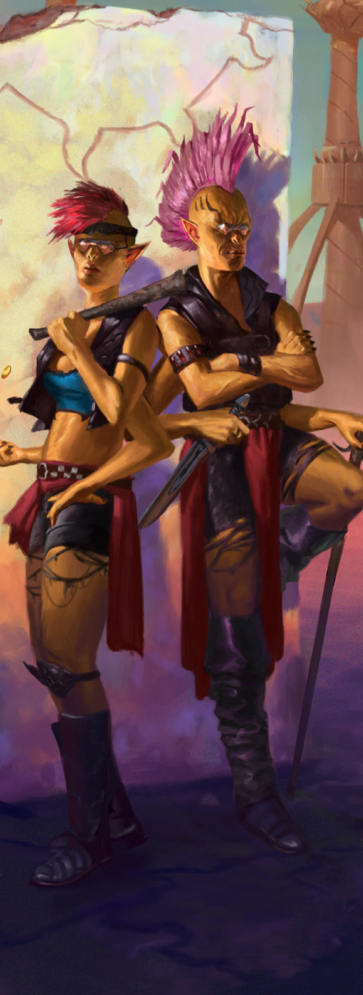
Riftborn are marked from birth by a distortion that never leaves them, and which tradition ties to an ancient rupture in space and time. Nothing reliable survives about that event; there is no account of what it was, when it happened, or how far it reached, only the certainty that it did, carried in the bodies of the people who bear its mark. It was not the Sundering. The histories that survive the Sundering are thin, but they are not so thin that the riftborn are missing from the ones before it. Time behaves strangely near a riftborn. Moments arrive a little early or a little late, memories slip out of order, and brief flashes of things that might yet happen pass behind their eyes. These flashes are never reliable, often painful, and always unwelcome.
Their bodies show the condition as plainly as their perception does. Every riftborn has four arms, a light and flexible frame, and crystalline facets where other peoples have eyes. Scholars argue over whether these traits came with the rupture or were there before it, but their use is not in dispute: the faceted eyes hold several points of focus at once, and the second pair of arms lets a riftborn act on two things without choosing between them. It is a body suited to a life in which attention is always being pulled in more than one direction.
The strangeness shows in small ways. A riftborn's movements and speech carry a slight irregularity, a sense of being a fraction out of step with the world around them, and the people of the Vale are wary of it. Some read the riftborn as omens. Some say they are touched by an odd magic. Neither is meant, and neither is true, but a riftborn learns early that the reading is not theirs to control. They have no homeland and no settlement of their own. They live where they are accepted, and many drift from place to place looking for the quiet corners where a slipped moment draws the least attention.
Their names are part of the strangeness. Riftborn names come out awkward in the mouth, opening on consonants nobody expects and ending where a name should not end, as though an ordinary name had been taken apart and put back together in the wrong order. A riftborn raised by another people may carry an ordinary name instead, and a riftborn who has kept one is making a point.
Long exposure to uncertainty produces habits. Riftborn watch before they act, think before they answer, and notice change before anyone else in the room. Where they are misunderstood, this reads as evasion. Where they are not, they become known as keen observers, patient thinkers, and steady companions, the last being the quality that surprises people most. They move through the world carefully, knowing better than anyone that time does not always run as smoothly as everyone else believes.