Ancestry
Human
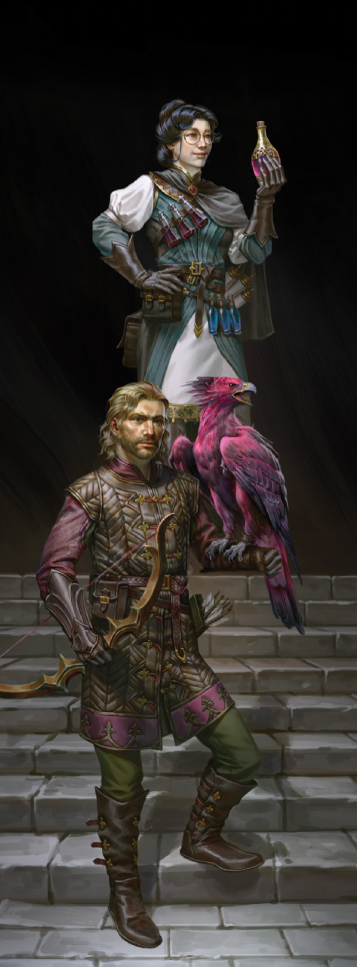
Humans have no common look. They are tall and short, broad and slight, and every shade the Vale holds; nothing about a human's face tells you where their family came from. Among the peoples of the Vale they are the hardest to generalise about, and the most numerous.
What humans share is a sense. They feel the supernatural before they see it — an oily smell in the air, a prickle on the skin, hair rising when the undead are near. Graveyards press on them in a way few of them can explain. Magic's hold on them is light, and whatever drives the undead, something in human nature refuses it.
They have no shared story of where they came from. Every district and family keeps its own account, none of the accounts agree, and few humans think the question important. Ask a human what they are and they will name a town, a trade, or a household before they name a maker.
What they do instead of remembering is build. Villages, guilds, caravans, households, and alliances form quickly wherever humans settle, and the bonds are made from shared labour and lived experience rather than blood. Stability is treated as work — everyone's, all the time. The world feels unpredictable to a people who can smell it coming, and their answer is to bind themselves together.
They are the most numerous people of the Vale, and the majority in most of its settlements. A human town is rarely a human place alone: they build to be joined, and most of the mixed quarters of the Vale began as human streets that other peoples moved into and were welcome.
In any community, humans tend to hold the connective work — the reeve, the clerk, the innkeeper, the caravan master, the neighbour who knows everyone's name. Gathering people into something larger than the sum of its parts is the thing humans are best at.
They meet the unknown with caution first and stubborn bravery after. No one can say why humans sense what the other peoples do not, and humans rarely discuss it. They light their lamps at dusk, wall their towns, bury their dead carefully, and are seldom caught unprepared.
Last updated: 9 September 2026