Ancestry
Polder
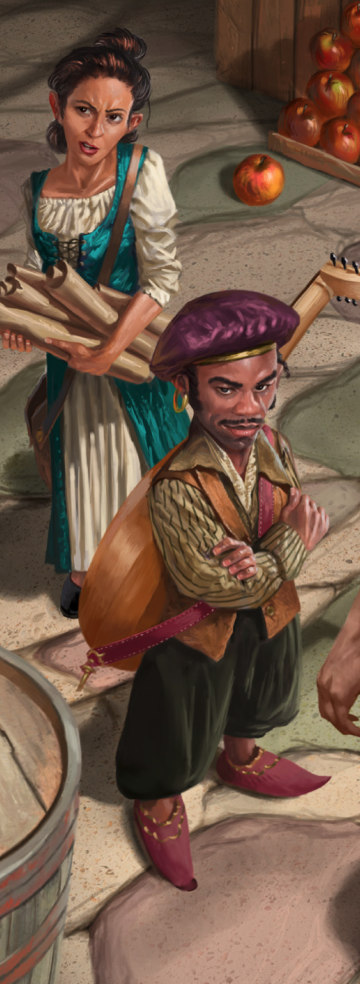
Polders stand about three and a half feet tall, and they are built like the big folk in miniature, not like children. Parts of the Vale say halfling instead; polders answer to both. They dress well when they can, and they carry themselves with complete self-possession: a polder does not consider themselves small so much as they consider most other people unnecessarily large. After humans they are the most numerous people of the Vale.
Their talent is called shadowmelding, and it is stranger than its reputation. A polder against a wall or floor does not hide in the shadow — they become it, flat and silent, until they choose to step out again. Polders themselves insist the talent is overrated. The big folk, they point out, are simply loud: the walk, the sitting down, the standing up, every one of them announced. A polder does quietly what everyone else does noisily, and is called uncanny for it.
Ask where polders come from and the answer is here. They have no migration story, no maker, and no memory of ever having arrived; as far as any polder is concerned, polders have always been wherever people gather. Scholars find this unsatisfying. Polders do not.
They live where others live — most of all where humans live, whose customs, jokes, and rhythms they absorb without effort. There are polders in every town from the Fingers to the sea, and few inns or kitchens anywhere without one somewhere about the place. Their faith follows the local custom, offered to the same Saints as their neighbours — and many towns proudly claim a polder saint of their own.
They are at their best in the trades of welcome — the inn, the kitchen, the market stall — and in any work where knowing everyone is the skill. They take poorly to instruction, and they know it: everybody wants a polder cook, as the saying goes, until they try to tell one what to cook.
The shadow talent has earned them a long reputation as thieves and spies. Polders dispute the charge, pointing at the inns and the kitchens, and for most polders the dispute is fair. But polders who are not upstanding tend to be too good at thieving to be caught. What annoys a polder is not the accusation but the assumption.
One more thing is commonly said of them, and it is true: they are the hardest people in the Vale to frighten. Nobody has explained why courage settled so heavily in the smallest of the peoples. Polders do not explain it either.
Last updated: 11 September 2026